Queen of France
The Three MusketeersQueen of France occupies the unstable center of the novel's court politics. She is a queen whose position should command authority, yet the evidence repeatedly presents her as abandoned by the king, watched by Cardinal Richelieu, and vulnerable to betrayal. Her private relationship with the Duke of Buckingham becomes the point at which intimacy, dynastic anxiety, espionage, and the impending conflict between France and England converge. Although she rarely controls events openly, her fears and decisions send other people across locked rooms, guarded borders, and hostile seas.
Identity and Political Position
The queen's public role is inseparable from the pressure placed upon her marriage and the succession. In the Musketeers' conversation, Aramis implies that Buckingham's presence in France carries a scandalous meaning, while Porthos rebukes him and insists that the queen is still young enough to give an heir to the crown of France. The exchange reveals how her fertility is treated as a matter of public politics rather than private life: the queen's body is discussed as a condition of dynastic security, and Buckingham's association with her is dangerous precisely because it threatens the court's official interpretation of her marriage and loyalty.
Her political isolation is made explicit through Monsieur Bonacieux's account of information passed from his wife. Constance Bonacieux is the goddaughter of Monsieur Laporte, the queen's confidential attendant, and Laporte placed her near the queen so that she would have someone in whom she could trust. The queen is described as abandoned by the king, watched by the cardinal, and betrayed by everybody. This network of confidence is therefore not ornamental court service: it is a defensive structure created because ordinary royal protection has failed.
Buckingham and the Threat of the False Message
The queen believes that someone has written to the Duke of Buckingham in her name, drawing him to Paris in order to trap him. The forged message turns a private bond into an instrument of political persecution. Buckingham does come to Paris on the faith of the pretended message, and once he understands that it is a snare, he does not immediately return to England. Instead, he declares that he will not depart without seeing the queen, forcing her to confront the danger created by both his devotion and the plot against him.
The queen initially refuses to see Buckingham, but she eventually fears that his frustration may drive him to commit some folly. She decides to meet him and urge his immediate departure. The plan depends on Constance Bonacieux, who is charged with bringing Buckingham to the Louvre; however, Constance is abducted, and for two days no one knows what has become of her. Once Constance is free and able to communicate with Monsieur Laporte, the suspended plan resumes, and she undertakes the perilous mission three days later than intended.
The meeting itself takes place through concealment and controlled movement. Constance leads Buckingham through a servants' door and a series of corridors and staircases inside the Louvre, then locks him alone in a lamp-lit apartment. Buckingham is literally made a prisoner by the very escort intended to bring him safely to the queen. Yet the narrative stresses that he feels no fear: his bravery, rashness, and appetite for romantic adventure make danger part of his conception of love. The queen's attempt to protect both him and herself thus produces an encounter structured by confinement, secrecy, and the possibility of discovery.
Gifts, Trust, and Transnational Risk
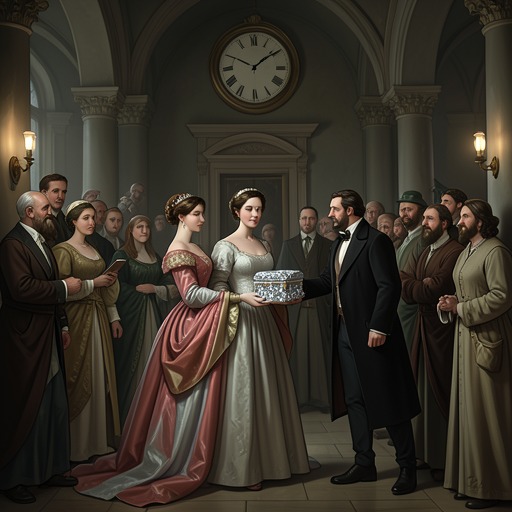
When the queen finally meets Buckingham, she gives him a rosewood casket bearing her cipher in gold and asks him to keep it in her memory. The object condenses their relationship into a portable secret. It is at once a love token, a sign of royal identity, and a dangerous piece of evidence. The queen cannot offer Buckingham a public acknowledgment; instead, she transfers affection through an object whose value lies in both its material beauty and its connection to her authority.
The later diamond mission shows how quickly such personal exchange becomes international political action. D'Artagnan reaches Dover after a difficult crossing, arrives in London with Planchet, and finds Buckingham by following the duke's name from one person to another despite knowing neither London nor English. Buckingham gives d'Artagnan access to a chamber adjoining his own because he wants someone close to whom he can speak about the queen. Their private attachment therefore shapes the physical arrangement of the mission: d'Artagnan is not merely a courier but a trusted witness to Buckingham's continuing preoccupation with her.
The English order forbidding every vessel bound for France to leave port, including the packet boat carrying letters, is understood by everyone as a declaration of war. Against that background, Buckingham has two diamond studs made as exact imitations of the jewels required by the queen's court obligations. The copies are so perfect that neither Buckingham nor experts can distinguish them from the originals. He gives the studs to d'Artagnan while keeping the more precious rosewood casket, explaining that the casket is all that remains to him. The exchange reverses the usual hierarchy of value: the diamonds serve the queen's immediate political need, while the casket preserves the intimate remainder of the relationship.
D'Artagnan later tells M. de Treville that the diamond came from the queen and that she gave it to him herself. The jewel is recognized as a true royal ornament, worth a thousand pistoles if it is worth anything at all. Its movement from the queen to d'Artagnan, through Buckingham's hands and across the Channel, makes the private relationship materially legible while also exposing every participant to danger. In this network, gifts do not simply express affection; they create obligations, authenticate messages, and threaten to reveal the concealed bond that produced them.
War, Surveillance, and Consequences
The queen's peril expands beyond the forged letter and the diamond studs. Cardinal Richelieu's siege of La Rochelle is directed against the last remaining stronghold of French Calvinism, a city whose port is also the last in France open to the English. The conflict therefore joins religious division, foreign intervention, and control of maritime access. Soldiers and adventurers from Spain, England, Italy, Germany, and Lorraine gather around the Protestant cause, making the queen's private communications part of a much wider European field of alliances and suspicion.
The danger becomes more concrete when an envoy of Buckingham named Montague is captured. Evidence is obtained of a league involving the German Empire, Spain, England, and Lorraine against France, and papers found in Buckingham's abandoned lodging appear to confirm the alliance while compromising Madame de Chevreuse and consequently the queen. Whether the papers reflect the queen's actual political conduct or merely the consequences of her association, they place her under the cardinal's scrutiny. Her personal connection with Buckingham is thus made to bear the weight of an international conspiracy.
The narrative repeatedly places the queen's identity at the intersection of visibility and concealment. Her name can summon a duke across the sea, her cipher can make a casket politically hazardous, and her jewels can require a high-speed courier's journey through wartime England. Yet the queen herself must act through trusted intermediaries: Monsieur Laporte, Constance Bonacieux, Buckingham, and d'Artagnan. This dependence reveals the structural limits of her power. Royal status gives her symbolic authority, but surveillance forces her practical agency into corridors, private apartments, coded objects, and personal loyalties.
Narrative Significance
Queen of France is less a conventional battlefield actor than the hidden cause around which the novel's major movements organize themselves. The forged message brings Buckingham to Paris; the queen's fear makes Constance's mission necessary; Constance's abduction delays the meeting; the queen's gift sends d'Artagnan to London; the diamond studs carry the consequences of the affair back toward the French court; and the discovery of Buckingham's papers enlarges the private crisis into a threat to the state.
Her significance also lies in the contrast between ceremonial power and exposed vulnerability. The queen's position makes her the object of dynastic expectation, royal suspicion, and political surveillance, but it does not free her to speak or move openly. Her most consequential actions are mediated through others and embodied in gifts that travel farther than she can. The result is a character whose apparent absence from public action is itself a form of narrative force: the court, the road, the sea crossing, and the war all become charged by the danger of reaching her, protecting her, or proving what she has meant to those around her.